

Search engine optimization (SEO) is an organic marketing channel designed for long-term growth, while Google Ads is a paid channel that can drive results quickly. Learn when to use SEO vs. Google Ads and discover how these tactics complement each other.
Both Google Ads and SEO can help you reach key digital marketing goals and grow your business.
So, how do you choose between these two channels? And is one truly better than the other?
In this article, we’ll compare SEO and Google Ads, cover when to use each, and explore which is ultimately best for your business, with expert insights from Sam Yadegar, co-founder and CEO of HawkSEM.
SEO vs. Google Ads: What’s the difference?
Google Ads and SEO are digital marketing strategies that help increase traffic, brand awareness, and conversions through search engines.
SEO takes more time and less money up front, while Google Ads yields faster results for a higher budget.
Here are the biggest contrasts between the two digital marketing strategies, plus the pros and cons of each.
Inbound vs. outbound
SEO is a type of inbound marketing. It relies on organic strategies to attract potential customers naturally.
Think of SEO as a customer-driven approach. Prospects typically find organic SEO content by searching Google or Bing for relevant keywords.
In contrast, Google Ads is a type of outbound marketing. It allows advertisers to reach out to new customers and promote products or services via paid placements.
Think of Google Ads as a business-driven approach. Prospects typically see paid ads when they’re consuming or searching for other kinds of content.
Channels and placements
Google Ads appear across Google properties and partner networks. You can use Google Ads to advertise your business via Google search, the GDN, YouTube, Gmail, and Discover.
SEO also leverages Google search, using Google’s algorithm to boost visibility. In addition, you also need content marketing to improve your business’s online presence.
Desired outcomes
SEO focuses on making your website and business more visible to search engines like Google.
Succeeding with SEO means ranking your site higher (ideally at or near the top of the search engine results page or SERP) for relevant keywords in Google search results.
While SEO is all about attracting organic search traffic, it can drive other outcomes too. People who find your site via Google search may complete other actions like subscribing to your email list or making a purchase.
Google Ads goes above and beyond website traffic, targeting a much wider range of outcomes. When you build Google Ads campaigns, you can choose the objective you want to achieve, including:
- Awareness and consideration
- Website traffic
- Leads
- Sales
- App promotion
- Local store visits and promotions
(Image: Screenshot)
Speed of results
Google Ads can generate almost immediate results. Once you launch a campaign, it starts competing in the ad auction. As long as your ads have a high Quality Score and a competitive bid, they can deliver results instantly.
The same outcome is true when your PPC campaigns end. The moment you shut them off, they stop appearing across Google properties and cease to deliver results.
The timeline for SEO is much more variable. An SEO campaign could lead to small wins relatively quickly. But more substantial results like increased traffic and higher rankings typically take several months.
However, SEO results don’t stop if you put a pause on content production or link building. Instead, it continues to pay off for much longer, especially if your SEO strategy revolves around high-quality content.
Further reading: How Long Does SEO Take to Work?
Upfront vs. ongoing work
Of the two marketing strategies, SEO requires the most ongoing work. A typical SEO campaign involves ongoing on-page optimization, link building, content production, and technical updates.
Google Ads campaigns can certainly benefit from routine optimizations and updates. But most of the effort that goes into Google Ads happens at the very beginning, during campaign setup.
Further reading: Content Refresh: How to Update & Republish Content For Higher Rankings
Cost
The cost of any marketing initiative depends on a long list of factors, including your goals, timeline, and initial investment.
Technically, either Google Ads or SEO could cost more. But there’s one key difference:
- With Google Ads, you pay every time someone clicks on your ad, whether or not they end up completing a conversion. If you get a lot of clicks without many conversions, Google Ads could get expensive.
- With SEO, you don’t pay for traffic. Since there’s no cost per click (CPC), SEO generates what may seem like free traffic. However, you do have to pay for things like staff, software, and content.
Further reading: Search Engine Marketing Costs Explained: What to Expect
Scalability
Compared to SEO, Google Ads is much easier to scale. Once you identify a campaign or ad that meets or exceeds your return on investment (ROI) goals, you can scale it in seconds.
To drive more results with Google Ads, you can increase the campaign budget or expand the audience. You do need a bigger advertising budget, but you don’t need to do much extra work to scale.
In contrast, scaling SEO requires a bigger budget, more work, and potentially a larger team. Scaling SEO can involve a variety of tactics, including:
- Producing more search-driven content
- Optimizing existing website elements
- Securing more guest posting opportunities
- Investing in link building
What is SEO?
SEO is an organic marketing strategy focused on making your website and its content more visible to search engines like Google.
The main goal for SEO is to attract more organic search traffic. In many cases, this traffic may lead to secondary outcomes like sales or phone calls.
Many distinct elements work together to power SEO. They include:
- Keyword research: Keyword research identifies the terms people use to find information related to your brand, products, or services. It also involves analyzing factors like search volume, search intent, and keyword difficulty.
- On-page optimization: Incorporate your keyword research into webpages, title tags, and meta descriptions to make your website content more visible in search results. On-page SEO efforts also involve setting up your website architecture for SEO, adding internal links, and inserting external links.
- Content creation: Once you know which search terms drive organic traffic, you can build content marketing campaigns and publish blog posts, reports, ebooks, and other kinds of content that address the intent behind relevant keywords.
- Off-page optimization: Off-page tactics include external link building, securing brand mentions, and publishing guest posts with backlinks to your website. Although off-page SEO doesn’t happen directly on your website, it can still improve how your website ranks in organic search results.
- Technical optimization: A technical SEO strategy typically focuses on updating sitemaps, improving page speed, fixing broken links, and addressing duplicate content issues.
What is Google Ads?
Google Ads is an advertising platform that delivers paid search or pay-per-click (PPC) ads to your target audience.
As a marketer, you can use Google Ads to achieve goals throughout the funnel, ranging from awareness to consideration to conversion.
A successful PPC strategy can include several Google Ads formats:
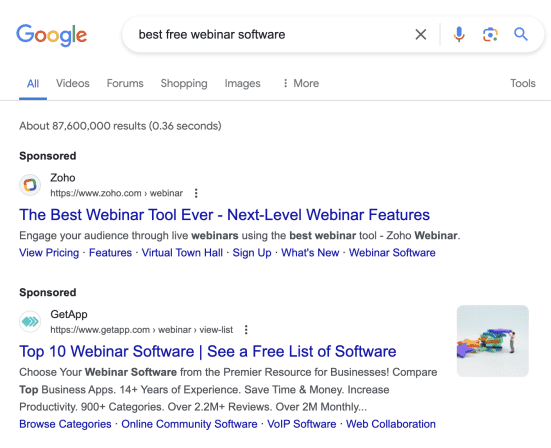
Paid search ads trigger when a prospect searches for a keyword you’ve targeted. These responsive text-based ads appear on SERPs, like in the example below.
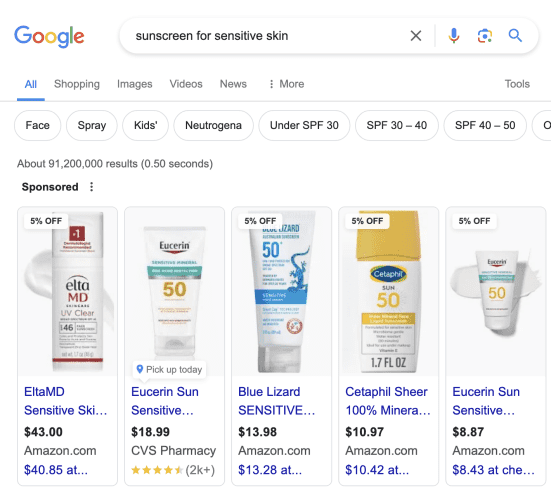
Shopping ads also trigger based on search queries. Like responsive search ads (RSAs), shopping ads appear on SERPs. But as the example below shows, they focus exclusively on products and include minimal text.
Display ads appear across millions of websites in the Google Display Network (GDN). These image-based ads can retarget prospects by showing products or services you’ve viewed before, like the example below.

Video ads appear before, during, or after long-form YouTube videos and shorts. These video ads generate views, but they can also drive viewers to your website, where they may complete a conversion.

Google Ads also has campaign types that automatically advertise across networks and placements. Demand Gen ads appear on YouTube, in Gmail, and in the Discover feed.
Performance Max campaigns (PMax) can access all Google Ads inventory across search, display, shopping, YouTube, Gmail, and Discover.
Further reading: Google Ads Campaign Types Explained (+ When to Use Them)
SEO vs. Google Ads: Which is better for your business?
You’ll be hard-pressed to find a marketing expert who says you only need one of these tactics in your digital marketing plan. Rather, there’s a time and a place for each.
Many brands succeed by using the two approaches strategically. In fact, “the highest performing digital marketing campaigns use a healthy mix of both,” shares Yadegar.
SEO and paid search often work better together. Use these ideas to take a holistic approach and leverage them both.
Maximize real estate on the SERP
Why put all your efforts into ranking for an important organic keyword or bidding for it via Google Ads when you can do both at once?
When you have high-performing search ads and organic content, your business takes up more real estate on the SERP, which can improve click-through rates and conversion rates.

Above, a QuickBooks ad appears at the top of the SERP for the search “best accounting software for small business.”
A QuickBooks product page appears organically on the same SERP, giving potential customers multiple opportunities to click.

Test search keywords
When you invest in SEO, you need confidence that you’re targeting the right keywords. After all, targeting the wrong keywords can waste resources — but you may not realize the error until a lot of time has passed.
Unsure which keywords are the best fit for your audience? Create a Google search campaign to test them.
With Google Ads, you can collect data quickly. Once you see which keywords best fit search intent and drive conversions, you’ll have a better idea of which keywords to optimize for in organic content.
Remarket to engaged audiences
Potential customers often click through to SEO content as they research issues and consider solutions. But you can’t expect them to convert on the first (or even the second) click.
So, how do you get them to complete a conversion? Remarketing can help.
Use Google Ads to retarget engaged prospects and encourage them to return to your site.
From display ads and YouTube ads to Gmail ads and bottom-funnel (BOFU) search ads, you have plenty of opportunities to reconnect with prospects and guide them toward a conversion.
When should you use SEO?
It’s a good idea to prioritize SEO over Google Ads in any of the following situations:
You want a long-term solution
One of the biggest benefits of SEO is that it can continue to generate traffic, provide visibility, and attract backlinks for months or years, even if you scale down content production or on- and off-page optimization efforts.
In some cases, a single piece of high-quality content targeting a high-volume search term can rank on the first page of Google for an extended period of time. As a result, SEO is a smart choice for a long-term solution.
Further reading: How Long Does SEO Take to Work?
Organic traffic is your main goal
When you target the right keywords, SEO can certainly drive conversion-focused outcomes. For example, targeting BOFU keywords can attract customers who are ready to buy.
However, the main goal of SEO is to increase organic traffic. It’s great for getting more eyes on your content.
You don’t expect immediate results
In some cases, SEO can lead to small gains quickly. For example, if you publish a new ultimate guide on a subject where your site already has topical authority, it could start ranking and getting backlinks right away.
But you won’t see the full impact of your SEO strategy for a while — typically several months. It’s a much better choice for brands looking to make a long-term investment instead of meeting a short-term goal.
Relevant keywords have sufficient search volume
SEO revolves around organic search. If the keywords related to your brand, category, product, or service generate enough search volume, SEO tends to be a good choice for achieving goals.
Compared to PPC, SEO is also a better option when “BOFU (buyer ready) keywords are slim to none on the paid side,” explains Yadegar.
“With SEO, a brand can bring in more qualified leads and sales, focusing on creating content that addresses a searcher’s pain points, not necessarily a focus keyword.”
“For example,” he continues, “the keyword ‘anxiety calming device’ does not have substantial search volume. But writing content on a topic like ‘ways to manage stress’ can yield a high volume of potential customers via SEO.”
Advertising costs are too high
Before you even consider running Google Ads, it’s a good idea to check Google Keyword Planner to estimate how much you’ll have to bid to place ads at the top of the SERP.
If the estimate doesn’t fit your budget, SEO is a much better choice. Since SEO doesn’t have a CPC, you can use it to run more cost-effective marketing campaigns.
When should you use Google Ads?
You’re better off focusing on Google Ads over SEO in any of the following situations:
You need immediate results
Need to start scaling leads or sales yesterday? Google Ads is a better choice when you need to generate revenue-focused results quickly.
As long as you outperform competing advertisers with higher bids, ads that resonate with the target audience, or a superior landing page experience, you can start getting impressions, clicks, and conversions right away.
You want a short-term solution
Google Ads can certainly be a long-term play. For example, you can run evergreen brand awareness or lead generation ads and continue to get excellent results for months on end.
However, Google Ads isn’t always a solution brands intend to use forever. Paid search, display, and shopping ads are ideal for reaching specific short-term goals with a preset ad spend, especially for small businesses.
Further reading: How Long Does PPC Take to Work? (+ How to Make Sure It Does)
Ranking organically for relevant keywords is too challenging
SEO isn’t a failsafe strategy. Just because you optimize your website and publish high-quality content doesn’t mean your pages will rank or drive traffic.
“When organic competition is extremely fierce and dominated by large brands, Google Ads is a more effective way to garner new leads and sales,” advises Yadegar.
For example, if the keyword difficulty suggests that a keyword is incredibly competitive, it may not be worth trying to rank for the term — at least not in the near future.
Instead, use Google Ads to place your website at the top of the page and rank above organic search results.
You want to reach potential customers beyond search alone
Search ads are a big part of Google Ads. But they aren’t your only option to leverage this advertising platform.
With Google Ads, you can also connect with potential customers as they watch YouTube or browse other publishers’ websites. You can also meet them in their Google inboxes or as they scroll the Discover feed.
The takeaway
To reach key marketing goals, it’s often best to leverage both SEO and PPC. With this approach, you can reach both long- and short-term marketing goals while expanding your customer base and growing your business.
Both PPC and SEO are core competencies for HawkSEM. Reach out to learn how our experienced team can work with you to build cost-effective search engine marketing (SEM) campaigns that drive real results.
This article has been updated and was originally published in May 2024.
Berita Terkini
Berita Terbaru
Daftar Terbaru
News
Berita Terbaru
Flash News
RuangJP
Pemilu
Berita Terkini
Prediksi Bola
Technology
Otomotif
Berita Terbaru
Teknologi
Berita terkini
Berita Pemilu
Berita Teknologi
Hiburan
master Slote
Berita Terkini
Pendidikan
Togel Deposit Pulsa
Daftar Judi Slot Online Terpercaya
Slot yang lagi gacor


