Many successful affiliate programs are often a hybrid of sub-affiliate and direct relationships. These programs leverage sub-affiliate networks for broad reach, discovery, and scale, while using direct partnerships to nurture top-tier partners.
What should I look for in a sub affiliate network?
When evaluating a sub-affiliate network, you should look for a partner that provides transparency, control, and performance-focused tools. Key features to look for include:
Publisher transparency: Before contracting, ask if the network will use Shared IDs to give you full visibility into their publisher base.
Granular controls: A reliable network should allow you to implement safeguards. This includes the ability to blacklist sensitive or misaligned publisher types you don’t want promoting your brand.
Performance-based compensation: Look for networks that support a cost-per-action (CPA) model. With CPA, you only pay when a specific action occurs, such as a sale or signup, which protects your budget and ensures you pay for results.
Robust data and analytics: The network should provide access to dashboards with detailed, data-driven insights on conversions, audience behavior, and campaign performance. This allows you to fine-tune underperforming strategies and double down on what’s working.
Should your affiliate program be on a network or in-house?
That depends on your goals and resources. A hybrid partnership model is often ideal, allowing brands to leverage subnetworks for scale and speed and direct partners for depth and control.
Subnetworks can help achieve specific objectives, such as:
Rapidly scaling and penetrating new markets
Targeting specific, high-intent audiences within a niche
Driving time-sensitive promotional goals, like clearing excess inventory or running a flash sale
Boosting SEO performance through backlinks from high-ranking partner sites
However, the investment comes with risks. Brands are often cautious about the return on investment due to network override fees that can make the model feel like “pay to play”. There is also a lack of direct control.
Many successful affiliate programs are often a hybrid of sub-affiliate and direct relationships. These programs leverage sub-affiliate networks for broad reach, discovery, and scale, while using direct partnerships to nurture top-tier partners.
What should I look for in a sub affiliate network?
When evaluating a sub-affiliate network, you should look for a partner that provides transparency, control, and performance-focused tools. Key features to look for include:
Publisher transparency: Before contracting, ask if the network will use Shared IDs to give you full visibility into their publisher base.
Granular controls: A reliable network should allow you to implement safeguards. This includes the ability to blacklist sensitive or misaligned publisher types you don’t want promoting your brand.
Performance-based compensation: Look for networks that support a cost-per-action (CPA) model. With CPA, you only pay when a specific action occurs, such as a sale or signup, which protects your budget and ensures you pay for results.
Robust data and analytics: The network should provide access to dashboards with detailed, data-driven insights on conversions, audience behavior, and campaign performance. This allows you to fine-tune underperforming strategies and double down on what’s working.
Should your affiliate program be on a network or in-house?
That depends on your goals and resources. A hybrid partnership model is often ideal, allowing brands to leverage subnetworks for scale and speed and direct partners for depth and control.
As affiliate marketing spend climbs toward a projected $16 billion in 2028, partnership managers face growing pressure to deliver results.
However, the manual, time-consuming work of recruiting, onboarding, and managing partners can hinder even the best program’s ability to scale effectively. This forces teams into a difficult position: sacrifice growth for the sake of control or risk brand safety and budget efficiency for the sake of scale.
Sub-affiliate networks offer a valuable way to bypass this dilemma. They deliver scale and can be a powerful tool when paired with the right strategy. Without a clear plan, they can lead to wasted spend on misaligned partners, but with the right approach, they provide significant revenue potential for brands.
In this guide, you’lllearn how to use sub-affiliate networks for efficient scaling and partner discovery, all while implementing the operational guardrails needed to protect your brand and budget.
You’ll also gain a process for identifying your top-performing partners and knowing precisely when to graduate them to high-ROI direct relationships, creating a truly sustainable and scalable affiliate program.
Key Takeaways
Use sub-affiliate networks for quick wins: Use subnetworks to rapidly launch campaigns, test new audiences, or run time-sensitive promotions. Focus on their ability to scale without the hassle of managing individual partners—perfect for when speed and simplicity are critical
Build direct partnerships with top performers: Identify your highest-performing partners and transition them to direct relationships. Offer tailored commissions, transparent reporting, and collaborative opportunities to maximize ROI and align on creative strategies.
Adopt a hybrid approach for balance: Combine the reach and discovery power of subnetworks with the strategic depth of direct partnerships. Use subnetworks to find new affiliates and direct relationships to nurture your most valuable partners, creating a scalable and sustainable program.
Analyze subnetwork traffic for quality: You can use tools like impact.com’s Performance by Referring Domain to pinpoint the affiliates driving the majority of your results, but ensuring your subnetworks use Shared IDs is the best way. Transition the top 20 percent of performers in-house for easier collaboration and better control over campaigns.
Implement operational safeguards: Protect your brand and budget by setting up payout groups, Shared-ID tracking, CPA-based compensation, and publisher blacklists. These controls ensure you’re rewarding partners who align with your goals and brand values.
Performance programs are like fingerprints—no two are the same. Some brands use sub-affiliate networks to promote their program more broadly. Others prefer to work directly with a handful of trusted affiliate partners who consistently drive traffic and revenue.
Many of the most successful brands adopt a hybrid model, using sub-affiliate networks for scale and discovery, while reserving direct relationships for high-value, strategic partners.
Let’s explore how these networks can scale your program and how direct partnerships offer the perfect complement.
Sub-affiliate networks provide scale and operational simplicity
Sub-affiliate networks are third-party platforms that connect brands to groups of publishers through a single relationship. Instead of managing dozens of individual partnerships, brands work with the network to handle onboarding, payouts, and campaign setup.
Subnetworks often focus on specific partner types, such as:
Websites, blogs, or publications within a specific niche
Dedicated email newsletters that offer targeted promotions or content
Influencers who specialize in generating awareness and sales on social media
Tech integrations that enhance operations, security, and customer experience
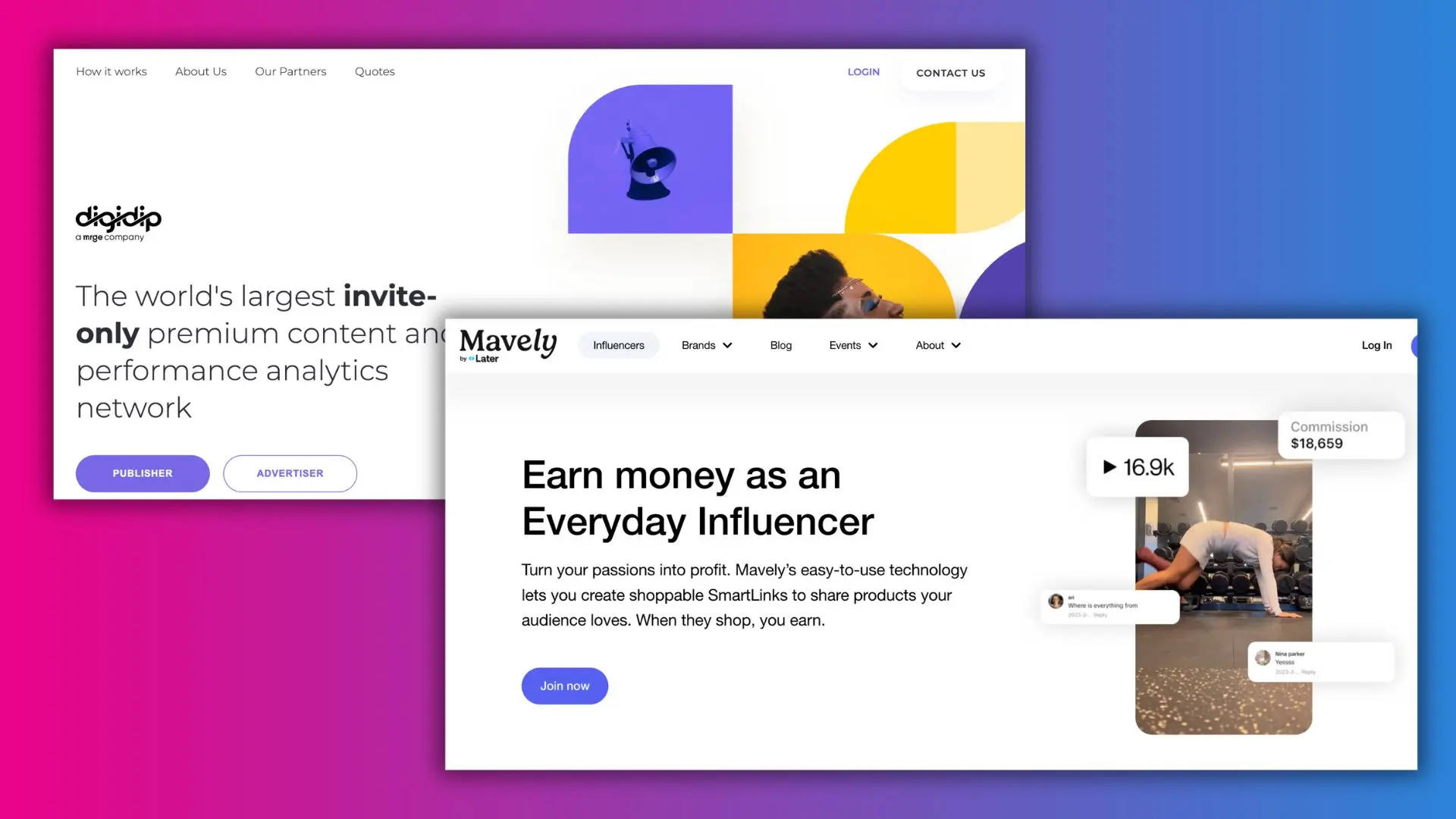
Subnetworks like Digidip bring together content publishers to work with brands, while those like Mavely focus on building a network of content creators.
What are the advantages of using sub-affiliate networks?
For brands, subnetworks:
Grant immediate access to many publishers. You can quickly reach hundreds—sometimes thousands—of potential partners without the operational lift of managing individual applications.
Facilitate rapid testing. You can test new audiences or markets without onboarding individual publishers.
Enable targeted reach. If you join a subnetwork that specializes in a specific niche, you can easily tap into publishers with high-intent followings.
Boost promotional power. Subnetworks alert affiliates of seasonal sales, excess inventory, or time-sensitive offers, making them a powerful tool for quickly moving stock or promoting flash sales.
Provide an SEO lift. You can gain additional backlinks from high-ranking partner sites faster, significantly boosting your SEO performance and search visibility.
What are the cons of using sub-affiliate networks?
Subnetworks also have some drawbacks:
Limited visibility into their publisher base. Subnetworks often limit transparency to prevent brands from poaching their high-performing affiliates, but this makes it more challenging to form direct partnerships.
Increased brand safety risks. When you don’t know who’s promoting your brand, you may potentially associate your brand with content, channels, or tactics that don’t align with your values.
Association with publishers who don’t fit your brand’s voice or audience. Some publishers within a subnetwork may not match your brand’s audience or vertical, creating confusion around your messaging.
Costs can add up. Network override fees can make subnetworks feel like a “pay-to-play” model, adding costs that cut into your margins.
Direct partnerships offer strategic depth and high-value growth
Direct partnerships are one-on-one relationships between brands and affiliates. These are trusted partnerships with top-performing publishers aligned with a brand’s voice and target audience.
You can work with hand-picked partners who align with your goals, enabling direct communication and bespoke collaboration.
Pros of direct relationships with affiliate partners
Compared to subnetworks, direct partnerships offer:
More transparency and control. You know precisely who is promoting you and how.
Greater creative alignment and brand protection. You gain more creative input and can collaborate with affiliates to maintain your brand voice and reputation.
Better ROI potential. A direct partnership eliminates fees associated with subnetworks, resulting in more budget for future campaigns.
Opportunity to tailor commissions, campaigns, and co-marketing strategies. Direct relationships create more opportunities to customize collaborations to benefit both you and your publishers.
Cons of direct relationships with affiliate partners
Direct relationships also come with a few drawbacks:
Slower to scale. Establishing meaningful relationships with affiliates requires time, making performance program expansion a gradual process.
Onboarding, contract negotiation, and support require more internal resources. Creating the appropriate documents and processes can be time-intensive, requiring additional hours to begin and maintain the partnership.
Heavier lift to test speculative partners or unknown verticals. Entering into a partnership with an affiliate who hasn’t proven their worth—especially if they’re outside of a brand’s vertical—is riskier because it requires more time and effort.
There are specific scenarios where sub-affiliate networks can become a core part of a sophisticated program growth strategy. Here are a few strategic scenarios where a sub-affiliate network offers an ideal solution.
You need rapid scale and market penetration
If your brand launches a new product or enters a new market, you may need to build momentum and generate widespread awareness immediately. However, many brands lack the internal resources to recruit, negotiate with, and onboard numerous new partners.
When time is of the essence, subnetworks enable brands to rapidly mobilize. You can skip the grunt work and partner with hundreds of affiliates ready to promote.
Subnetworks account for 12 percent of affiliate commissions, making them the fourth-largest revenue-generating publisher type in the industry.
Read
Brands can set participation parameters, such as “Post a video to your socials within one month.”
With hundreds of brand advocates signing up for the promotion, you can quickly gain increased visibility across multiple platforms and audiences.
“When a brand needs to launch a new line or product, subaffiliate networks allow them to quickly amplify their message to supercharge awareness and encourage sales.” – Natasha Palma, Senior Publisher Development Manager at impact.com
You need to target specific, high-intent audiences
Some brands need to connect with publishers within a specific niche to reach high-intent audiences. However, finding and recruiting these affiliate partners directly is a heavy lift—especially during high-visibility campaigns.
Niche-specific subnetworksprovide access to specialized publishers with high-intent followings. Instead of spending months on partner recruitment, you can turn to these trusted publishers to place your messaging directly in front of the right audience with minimal friction.
For instance, specialized companies like Neo could partner with finance publications, such as NerdWallet, to reach financially savvy audiences, effectively driving credit card sign-ups at scale.
You need to drive specific sales and promotional goals quickly
Your brand may need to drive targeted, time-sensitive sales to clear seasonal inventory or promote a flash sale.
Instead of individually onboarding and briefing dozens of partners, brands can launch a promotion through a subnetwork, which activates hundreds of affiliates across various channels.
With subnetworks doing the heavy lifting—distributing links, creatives, and messaging—brands gain broader coverage with minimal setup time, making them ideal for quick-turn campaigns.
If a brand runs an annual major sale, using sub-affiliates can be an effective way to quickly reach a large number of partners to promote it.
You need to boost SEO and brand domain authority
Traditional backlinking strategies are notoriously slow and often frustrating. You can spend hours pitching high-authority websites, only to be flagged as spam. This keeps even great content buried in what marketers call the “Google Graveyard.”
If you need to improve search visibility and build domain authority more quickly than traditional SEO efforts allow, subnetworks may provide a more scalable and performance-driven alternative. Many subnetworks include blog and editorial partners with strong domain authority.
Joining your affiliate program gives publishers a real incentive to feature your products, link to your site, and drive traffic. The results:
More high-quality backlinks
Improved search visibility
An SEO lift
Trackable affiliate sale
Source: Backlinko
For many brands, the idea of partnering with a sub-affiliate network comes with valid concerns, such as a lack of visibility into the publisher base, the potential to appear on misaligned channels, and the risk of wasting budget on unapproved partners.
To make subnetworks work for you, focus on intentional setup and campaign management. With the right operational safeguards, you can protect your brand’s reputation and ensure your investment drives measurable results.
Here’s what you can do to maximize your sub-affiliate network relationships.
Verify your subnetwork will provide Shared IDs for your partners
If you want your affiliate budget to go only to publishers you trust, then you’ll need to ask your subnetwork if they can provide Shared IDs.
“Getting Shared IDs provides full visibility into which publishers are promoting your products. If the network declines your request, consider partnering with a different subnetwork that will offer more transparency.” – Natasha Palma, Senior Publisher Development Manager at impact.com
When sub-affiliates provide Shared IDs in the impact.com platform, you can use payout groups to set contracts, so you only pay partners you’ve pre-approved.
This gives you more visibility and more control over where your commissions go, which can also help you prevent affiliate fraud.
Blacklist sensitive or misaligned publisher types
When affiliate offers appear on misaligned or low-trust publisher channels, it can weaken your message, damage credibility, and even hurt conversions.
To prevent this, ask if your subnetwork can blacklist sensitive publisher types, or those that fall outside of your verticals or campaign goals. This ensures your affiliates remain consistent with your brand, maintaining your brand image.
‘Blacklisting sensitive publisher types ensures your affiliates remain consistent with your brand. This keeps your reputation safe while still taking advantage of a subaffiliate network’s ability to quickly scale.” – Natasha Palma, Senior Publisher Development Manager at impact.com
Stick to the CPA compensation model
Subnetworks may offer multiple payment models, but for most performance-driven campaigns, cost-per-action (CPA) is the safest bet.
With CPA, you only pay when a specific action occurs, such as a sale, a signup, or a form fill. That means every dollar goes toward measurable results—not just impressions or exposure. It protects your budget and ensures publishers are rewarded for the results they produce.
Pay for real performance
Discover how to align your partner incentives with your business goals.
See the payment models
Lean on your subnetwork’s data tools
Most subnetworks provide access to robust dashboards that are loaded with performance data. Think conversion rates, audience behavior, and incremental insights.
Strategic partnership managers use these tools as a roadmapto:
Double down on what’s working
Fine-tune underperforming strategies
Pivot away from tactics that drain your budget and time
For example, if you notice a publisher drives a lot of traffic but has low conversions, the data may be telling you there’s a disconnect. This is an opportunity to refine your strategy by providing that publisher with a more tailored commission offer or different creative assets that will resonate better with their specific audience.
Test and learn as you go
Iteration is the name of the game when it comes to building strong affiliate programs. Without consistent testing, launching a campaign can feel like flying blind.
Start small and run low-risk campaigns with niche publishers—especially if you’re exploring new verticals or unfamiliar audiences. These micro-tests generate actionable insights without draining your ad budget.
As you pair small tests alongside bigger pushes, track customer lifetime value (LTV). Identifying which publishers deliver your most loyal, high-value customers helps you focus resources where they’ll drive the most long-term impact.
As your affiliate program evolves, you may spot partners who consistently outperform the rest. Entering into a direct relationship with these high achievers can incentivize more frequent promotions, generate more sales, and maximize your program ROI.
But how do you know if an affiliate partner is ready for the transition? Let’s look at a few key signs that you have a diamond in the rough.
4 signs it may be time to “graduate” a partner to direct
Strong performance. If a partner consistently ranks in the top 10–20 percent of your performers, take notice. These affiliates are already generating consistent results. Bringing them in-house gives you greater control and deeper alignment with your performance goals.
Strategic fit. If a partner has a high-value audience that consistently provides significant social proof or trust, it may be time to graduate them. Moving the relationship to direct opens the door to creative collaboration with partners who know how to engage—and convert—their communities.
More complex compensation. Subnetworks can limit your ability to reward standout partners. Direct relationships provide the flexibility to offer tiered commissions, bonuses, or co-branded campaigns that create better incentives for long-term growth.
Attractive cost-benefit. Direct relationships are one-on-one, which eliminates fees that eat into margins. A direct commission—even if it’s slightly higher than what’s offered on subnetworks—often nets a better return. So, if you want to maximize your margins, it’s time to cultivate direct relations.
Is it time to go Direct?
A 4-point checklist
Top-tier performance Are they consistently in your top 10–20% of performers?
Strategic audience fit Does their audience provide significant social proof and align perfectly with your brand?
Integrate promotions naturally Do you want to offer them complex incentives, such as tiered commissions, that your subnetwork doesn’t support?
Clear ROI advantage Will eliminating network fees maximize your margins, even with a higher direct commission?
How to create a smooth transition process for partners in 4 steps
Working with subnetworks can strategically surface top-performing brand advocates you might not have recognized otherwise. Once those partners prove their value, forging direct relationships offers greater control and more meaningful collaboration.
If you’re ready to build a roster of trusted publishers off-platform, follow these steps.
Step 1: Proactively identify candidates
The Pareto Principle says 80 percent of your results come from just 20 percent of your efforts. The same logic applies to your affiliate partners.
Identify the top 20 percent of performers within your subnetworks—these are the partners driving the majority of your conversions. In the impact.com platform, you can use reports like Performance by Referring Domain to surface these high-impact publishers.
These are your prime candidates for direct relationships that deliver even greater ROI.
Step 2: Conduct a cost-benefit analysis
Before jumping into direct relationships, take a moment to run the numbers.
Compare what you’re currently paying in network override fees against the potential cost of managing the partner directly. Don’t forget to factor in internal time, resources, and a potentially higher commission rate.
The math might reveal that going direct will boost ROI, or you may find that sticking with the subnetwork is more cost-effective for now.
If the numbers are correct, you’re in a strong position to pursue a high-value direct partnership.
Source: U.S. Small Business Administration
Step 3: Craft an offer that shows value
Just like publishers pitch brands, you need to present a compelling value proposition to entice top publishers to go direct.
Lead with what’s in it for them:
Offer a higher commission rate
Exclusive bonuses
Early access to promotions in exchange for moving off-platform.
Start with a personalized outreach and frame the transition as a strategic partnership—not just a transactional switch. A thoughtful pitch goes much further than a run-of-the-mill question.
Create better recruitment emails
Discover how to craft convincing emails that will help you land high-quality partners.
Get the templates
Step 4: Provide seamless onboarding
When it’s time to bring a partner in-house, establish a streamlined onboarding process. Give them easy access to everything they need, including:
Creative assets
Brand guidelines
Tracking links
Compliance docs
Removing early onboarding challenges makes the transition smooth and positions the direct relationship as an upgrade.
Partners who feel supported and valued from day one are more likely to stay engaged, perform well, and evolve into long-term brand advocates.
Strong affiliate programs are flexible, blending the broad reach of sub-affiliate networks with the precision of direct partnerships. Using both allows brands to scale quickly and strategically.
Sub-affiliate networks deliver speed, discovery, and access to diverse audiences, making them ideal for rapid growth and campaign testing. But when it comes to your top performers, it’s often worth going deeper.
Your top-performing partners have earned a seat at the table. Direct relationships with these proven performers enable richer collaboration, better brand alignment, and higher long-term ROI.
Ultimately, a dynamic, hybrid program is the formula for sustainable, scalable growth.
Ready to scale with confidence?
Discover, manage, and nurture both your sub-affiliate and direct partnerships with impact.com.
Request a demo
Discover more about how to maximize your affiliate program’s effectiveness:
FAQs
How do sub-affiliate networks work?
Sub-affiliate networks (or subnetworks) are platforms that connect brands to a large group of publishers through a single relationship. They manage the backend, like onboarding, payments, and compliance, so brands can scale quickly without managing each individual partner.
The process acts like a megaphone for a brand’s affiliate program. When a brand needs promotional support for a campaign, the subnetwork notifies its base of publishers about the opportunity. This allows brands to scale quickly and reach a variety of publishers without having to manage each one individually.
What is the difference between an affiliate program and a subnetwork?
An affiliate program includes all of a brand’s partners. Some affiliate partners are managed directly, while some are managed through a subnetwork. A subnetwork is a type of affiliate partner that manages other publishers.
How can I find reliable sub affiliate networks?
Brands can find reliable sub-affiliate networks by researching industry directories, tapping into professional communities, and attending marketing events for trusted recommendations. The impact.com platform also offers ways to discover, manage, and nurture relationships with both sub-affiliate networks and direct partners.
Analyzing which networks competitors use can also be a strategic shortcut to identifying partners with proven success in your vertical.
Once a shortlist is created, it’s crucial to directly engage with network managers to vet their publisher quality, compliance procedures, and industry expertise.
Are sub affiliate networks worth the investment?
Sub-affiliate networks may or may not be worth the investment depending on your affiliate program’s maturity and goals.
Subnetworks can help achieve specific objectives, such as:
Rapidly scaling and penetrating new markets
Targeting specific, high-intent audiences within a niche
Driving time-sensitive promotional goals, like clearing excess inventory or running a flash sale
Boosting SEO performance through backlinks from high-ranking partner sites
However, the investment comes with risks. Brands are often cautious about the return on investment due to network override fees that can make the model feel like “pay to play”. There is also a lack of direct control.
Many successful affiliate programs are often a hybrid of sub-affiliate and direct relationships. These programs leverage sub-affiliate networks for broad reach, discovery, and scale, while using direct partnerships to nurture top-tier partners.
What should I look for in a sub affiliate network?
When evaluating a sub-affiliate network, you should look for a partner that provides transparency, control, and performance-focused tools. Key features to look for include:
Publisher transparency: Before contracting, ask if the network will use Shared IDs to give you full visibility into their publisher base.
Granular controls: A reliable network should allow you to implement safeguards. This includes the ability to blacklist sensitive or misaligned publisher types you don’t want promoting your brand.
Performance-based compensation: Look for networks that support a cost-per-action (CPA) model. With CPA, you only pay when a specific action occurs, such as a sale or signup, which protects your budget and ensures you pay for results.
Robust data and analytics: The network should provide access to dashboards with detailed, data-driven insights on conversions, audience behavior, and campaign performance. This allows you to fine-tune underperforming strategies and double down on what’s working.
Should your affiliate program be on a network or in-house?
That depends on your goals and resources. A hybrid partnership model is often ideal, allowing brands to leverage subnetworks for scale and speed and direct partners for depth and control.
As affiliate marketing spend climbs toward a projected $16 billion in 2028, partnership managers face growing pressure to deliver results.
However, the manual, time-consuming work of recruiting, onboarding, and managing partners can hinder even the best program’s ability to scale effectively. This forces teams into a difficult position: sacrifice growth for the sake of control or risk brand safety and budget efficiency for the sake of scale.
Sub-affiliate networks offer a valuable way to bypass this dilemma. They deliver scale and can be a powerful tool when paired with the right strategy. Without a clear plan, they can lead to wasted spend on misaligned partners, but with the right approach, they provide significant revenue potential for brands.
In this guide, you’lllearn how to use sub-affiliate networks for efficient scaling and partner discovery, all while implementing the operational guardrails needed to protect your brand and budget.
You’ll also gain a process for identifying your top-performing partners and knowing precisely when to graduate them to high-ROI direct relationships, creating a truly sustainable and scalable affiliate program.
Key Takeaways
Use sub-affiliate networks for quick wins: Use subnetworks to rapidly launch campaigns, test new audiences, or run time-sensitive promotions. Focus on their ability to scale without the hassle of managing individual partners—perfect for when speed and simplicity are critical
Build direct partnerships with top performers: Identify your highest-performing partners and transition them to direct relationships. Offer tailored commissions, transparent reporting, and collaborative opportunities to maximize ROI and align on creative strategies.
Adopt a hybrid approach for balance: Combine the reach and discovery power of subnetworks with the strategic depth of direct partnerships. Use subnetworks to find new affiliates and direct relationships to nurture your most valuable partners, creating a scalable and sustainable program.
Analyze subnetwork traffic for quality: You can use tools like impact.com’s Performance by Referring Domain to pinpoint the affiliates driving the majority of your results, but ensuring your subnetworks use Shared IDs is the best way. Transition the top 20 percent of performers in-house for easier collaboration and better control over campaigns.
Implement operational safeguards: Protect your brand and budget by setting up payout groups, Shared-ID tracking, CPA-based compensation, and publisher blacklists. These controls ensure you’re rewarding partners who align with your goals and brand values.
Performance programs are like fingerprints—no two are the same. Some brands use sub-affiliate networks to promote their program more broadly. Others prefer to work directly with a handful of trusted affiliate partners who consistently drive traffic and revenue.
Many of the most successful brands adopt a hybrid model, using sub-affiliate networks for scale and discovery, while reserving direct relationships for high-value, strategic partners.
Let’s explore how these networks can scale your program and how direct partnerships offer the perfect complement.
Sub-affiliate networks provide scale and operational simplicity
Sub-affiliate networks are third-party platforms that connect brands to groups of publishers through a single relationship. Instead of managing dozens of individual partnerships, brands work with the network to handle onboarding, payouts, and campaign setup.
Subnetworks often focus on specific partner types, such as:
Websites, blogs, or publications within a specific niche
Dedicated email newsletters that offer targeted promotions or content
Influencers who specialize in generating awareness and sales on social media
Tech integrations that enhance operations, security, and customer experience
Subnetworks like Digidip bring together content publishers to work with brands, while those like Mavely focus on building a network of content creators.
What are the advantages of using sub-affiliate networks?
For brands, subnetworks:
Grant immediate access to many publishers. You can quickly reach hundreds—sometimes thousands—of potential partners without the operational lift of managing individual applications.
Facilitate rapid testing. You can test new audiences or markets without onboarding individual publishers.
Enable targeted reach. If you join a subnetwork that specializes in a specific niche, you can easily tap into publishers with high-intent followings.
Boost promotional power. Subnetworks alert affiliates of seasonal sales, excess inventory, or time-sensitive offers, making them a powerful tool for quickly moving stock or promoting flash sales.
Provide an SEO lift. You can gain additional backlinks from high-ranking partner sites faster, significantly boosting your SEO performance and search visibility.
What are the cons of using sub-affiliate networks?
Subnetworks also have some drawbacks:
Limited visibility into their publisher base. Subnetworks often limit transparency to prevent brands from poaching their high-performing affiliates, but this makes it more challenging to form direct partnerships.
Increased brand safety risks. When you don’t know who’s promoting your brand, you may potentially associate your brand with content, channels, or tactics that don’t align with your values.
Association with publishers who don’t fit your brand’s voice or audience. Some publishers within a subnetwork may not match your brand’s audience or vertical, creating confusion around your messaging.
Costs can add up. Network override fees can make subnetworks feel like a “pay-to-play” model, adding costs that cut into your margins.
Direct partnerships offer strategic depth and high-value growth
Direct partnerships are one-on-one relationships between brands and affiliates. These are trusted partnerships with top-performing publishers aligned with a brand’s voice and target audience.
You can work with hand-picked partners who align with your goals, enabling direct communication and bespoke collaboration.
Pros of direct relationships with affiliate partners
Compared to subnetworks, direct partnerships offer:
More transparency and control. You know precisely who is promoting you and how.
Greater creative alignment and brand protection. You gain more creative input and can collaborate with affiliates to maintain your brand voice and reputation.
Better ROI potential. A direct partnership eliminates fees associated with subnetworks, resulting in more budget for future campaigns.
Opportunity to tailor commissions, campaigns, and co-marketing strategies. Direct relationships create more opportunities to customize collaborations to benefit both you and your publishers.
Cons of direct relationships with affiliate partners
Direct relationships also come with a few drawbacks:
Slower to scale. Establishing meaningful relationships with affiliates requires time, making performance program expansion a gradual process.
Onboarding, contract negotiation, and support require more internal resources. Creating the appropriate documents and processes can be time-intensive, requiring additional hours to begin and maintain the partnership.
Heavier lift to test speculative partners or unknown verticals. Entering into a partnership with an affiliate who hasn’t proven their worth—especially if they’re outside of a brand’s vertical—is riskier because it requires more time and effort.
There are specific scenarios where sub-affiliate networks can become a core part of a sophisticated program growth strategy. Here are a few strategic scenarios where a sub-affiliate network offers an ideal solution.
You need rapid scale and market penetration
If your brand launches a new product or enters a new market, you may need to build momentum and generate widespread awareness immediately. However, many brands lack the internal resources to recruit, negotiate with, and onboard numerous new partners.
When time is of the essence, subnetworks enable brands to rapidly mobilize. You can skip the grunt work and partner with hundreds of affiliates ready to promote.
Subnetworks account for 12 percent of affiliate commissions, making them the fourth-largest revenue-generating publisher type in the industry.
Read
Brands can set participation parameters, such as “Post a video to your socials within one month.”
With hundreds of brand advocates signing up for the promotion, you can quickly gain increased visibility across multiple platforms and audiences.
“When a brand needs to launch a new line or product, subaffiliate networks allow them to quickly amplify their message to supercharge awareness and encourage sales.” – Natasha Palma, Senior Publisher Development Manager at impact.com
You need to target specific, high-intent audiences
Some brands need to connect with publishers within a specific niche to reach high-intent audiences. However, finding and recruiting these affiliate partners directly is a heavy lift—especially during high-visibility campaigns.
Niche-specific subnetworksprovide access to specialized publishers with high-intent followings. Instead of spending months on partner recruitment, you can turn to these trusted publishers to place your messaging directly in front of the right audience with minimal friction.
For instance, specialized companies like Neo could partner with finance publications, such as NerdWallet, to reach financially savvy audiences, effectively driving credit card sign-ups at scale.
You need to drive specific sales and promotional goals quickly
Your brand may need to drive targeted, time-sensitive sales to clear seasonal inventory or promote a flash sale.
Instead of individually onboarding and briefing dozens of partners, brands can launch a promotion through a subnetwork, which activates hundreds of affiliates across various channels.
With subnetworks doing the heavy lifting—distributing links, creatives, and messaging—brands gain broader coverage with minimal setup time, making them ideal for quick-turn campaigns.
If a brand runs an annual major sale, using sub-affiliates can be an effective way to quickly reach a large number of partners to promote it.
You need to boost SEO and brand domain authority
Traditional backlinking strategies are notoriously slow and often frustrating. You can spend hours pitching high-authority websites, only to be flagged as spam. This keeps even great content buried in what marketers call the “Google Graveyard.”
If you need to improve search visibility and build domain authority more quickly than traditional SEO efforts allow, subnetworks may provide a more scalable and performance-driven alternative. Many subnetworks include blog and editorial partners with strong domain authority.
Joining your affiliate program gives publishers a real incentive to feature your products, link to your site, and drive traffic. The results:
More high-quality backlinks
Improved search visibility
An SEO lift
Trackable affiliate sale
Source: Backlinko
For many brands, the idea of partnering with a sub-affiliate network comes with valid concerns, such as a lack of visibility into the publisher base, the potential to appear on misaligned channels, and the risk of wasting budget on unapproved partners.
To make subnetworks work for you, focus on intentional setup and campaign management. With the right operational safeguards, you can protect your brand’s reputation and ensure your investment drives measurable results.
Here’s what you can do to maximize your sub-affiliate network relationships.
Verify your subnetwork will provide Shared IDs for your partners
If you want your affiliate budget to go only to publishers you trust, then you’ll need to ask your subnetwork if they can provide Shared IDs.
“Getting Shared IDs provides full visibility into which publishers are promoting your products. If the network declines your request, consider partnering with a different subnetwork that will offer more transparency.” – Natasha Palma, Senior Publisher Development Manager at impact.com
When sub-affiliates provide Shared IDs in the impact.com platform, you can use payout groups to set contracts, so you only pay partners you’ve pre-approved.
This gives you more visibility and more control over where your commissions go, which can also help you prevent affiliate fraud.
Blacklist sensitive or misaligned publisher types
When affiliate offers appear on misaligned or low-trust publisher channels, it can weaken your message, damage credibility, and even hurt conversions.
To prevent this, ask if your subnetwork can blacklist sensitive publisher types, or those that fall outside of your verticals or campaign goals. This ensures your affiliates remain consistent with your brand, maintaining your brand image.
‘Blacklisting sensitive publisher types ensures your affiliates remain consistent with your brand. This keeps your reputation safe while still taking advantage of a subaffiliate network’s ability to quickly scale.” – Natasha Palma, Senior Publisher Development Manager at impact.com
Stick to the CPA compensation model
Subnetworks may offer multiple payment models, but for most performance-driven campaigns, cost-per-action (CPA) is the safest bet.
With CPA, you only pay when a specific action occurs, such as a sale, a signup, or a form fill. That means every dollar goes toward measurable results—not just impressions or exposure. It protects your budget and ensures publishers are rewarded for the results they produce.
Pay for real performance
Discover how to align your partner incentives with your business goals.
See the payment models
Lean on your subnetwork’s data tools
Most subnetworks provide access to robust dashboards that are loaded with performance data. Think conversion rates, audience behavior, and incremental insights.
Strategic partnership managers use these tools as a roadmapto:
Double down on what’s working
Fine-tune underperforming strategies
Pivot away from tactics that drain your budget and time
For example, if you notice a publisher drives a lot of traffic but has low conversions, the data may be telling you there’s a disconnect. This is an opportunity to refine your strategy by providing that publisher with a more tailored commission offer or different creative assets that will resonate better with their specific audience.
Test and learn as you go
Iteration is the name of the game when it comes to building strong affiliate programs. Without consistent testing, launching a campaign can feel like flying blind.
Start small and run low-risk campaigns with niche publishers—especially if you’re exploring new verticals or unfamiliar audiences. These micro-tests generate actionable insights without draining your ad budget.
As you pair small tests alongside bigger pushes, track customer lifetime value (LTV). Identifying which publishers deliver your most loyal, high-value customers helps you focus resources where they’ll drive the most long-term impact.
As your affiliate program evolves, you may spot partners who consistently outperform the rest. Entering into a direct relationship with these high achievers can incentivize more frequent promotions, generate more sales, and maximize your program ROI.
But how do you know if an affiliate partner is ready for the transition? Let’s look at a few key signs that you have a diamond in the rough.
4 signs it may be time to “graduate” a partner to direct
Strong performance. If a partner consistently ranks in the top 10–20 percent of your performers, take notice. These affiliates are already generating consistent results. Bringing them in-house gives you greater control and deeper alignment with your performance goals.
Strategic fit. If a partner has a high-value audience that consistently provides significant social proof or trust, it may be time to graduate them. Moving the relationship to direct opens the door to creative collaboration with partners who know how to engage—and convert—their communities.
More complex compensation. Subnetworks can limit your ability to reward standout partners. Direct relationships provide the flexibility to offer tiered commissions, bonuses, or co-branded campaigns that create better incentives for long-term growth.
Attractive cost-benefit. Direct relationships are one-on-one, which eliminates fees that eat into margins. A direct commission—even if it’s slightly higher than what’s offered on subnetworks—often nets a better return. So, if you want to maximize your margins, it’s time to cultivate direct relations.
Is it time to go Direct?
A 4-point checklist
Top-tier performance Are they consistently in your top 10–20% of performers?
Strategic audience fit Does their audience provide significant social proof and align perfectly with your brand?
Integrate promotions naturally Do you want to offer them complex incentives, such as tiered commissions, that your subnetwork doesn’t support?
Clear ROI advantage Will eliminating network fees maximize your margins, even with a higher direct commission?
How to create a smooth transition process for partners in 4 steps
Working with subnetworks can strategically surface top-performing brand advocates you might not have recognized otherwise. Once those partners prove their value, forging direct relationships offers greater control and more meaningful collaboration.
If you’re ready to build a roster of trusted publishers off-platform, follow these steps.
Step 1: Proactively identify candidates
The Pareto Principle says 80 percent of your results come from just 20 percent of your efforts. The same logic applies to your affiliate partners.
Identify the top 20 percent of performers within your subnetworks—these are the partners driving the majority of your conversions. In the impact.com platform, you can use reports like Performance by Referring Domain to surface these high-impact publishers.
These are your prime candidates for direct relationships that deliver even greater ROI.
Step 2: Conduct a cost-benefit analysis
Before jumping into direct relationships, take a moment to run the numbers.
Compare what you’re currently paying in network override fees against the potential cost of managing the partner directly. Don’t forget to factor in internal time, resources, and a potentially higher commission rate.
The math might reveal that going direct will boost ROI, or you may find that sticking with the subnetwork is more cost-effective for now.
If the numbers are correct, you’re in a strong position to pursue a high-value direct partnership.
Source: U.S. Small Business Administration
Step 3: Craft an offer that shows value
Just like publishers pitch brands, you need to present a compelling value proposition to entice top publishers to go direct.
Lead with what’s in it for them:
Offer a higher commission rate
Exclusive bonuses
Early access to promotions in exchange for moving off-platform.
Start with a personalized outreach and frame the transition as a strategic partnership—not just a transactional switch. A thoughtful pitch goes much further than a run-of-the-mill question.
Create better recruitment emails
Discover how to craft convincing emails that will help you land high-quality partners.
Get the templates
Step 4: Provide seamless onboarding
When it’s time to bring a partner in-house, establish a streamlined onboarding process. Give them easy access to everything they need, including:
Creative assets
Brand guidelines
Tracking links
Compliance docs
Removing early onboarding challenges makes the transition smooth and positions the direct relationship as an upgrade.
Partners who feel supported and valued from day one are more likely to stay engaged, perform well, and evolve into long-term brand advocates.
Strong affiliate programs are flexible, blending the broad reach of sub-affiliate networks with the precision of direct partnerships. Using both allows brands to scale quickly and strategically.
Sub-affiliate networks deliver speed, discovery, and access to diverse audiences, making them ideal for rapid growth and campaign testing. But when it comes to your top performers, it’s often worth going deeper.
Your top-performing partners have earned a seat at the table. Direct relationships with these proven performers enable richer collaboration, better brand alignment, and higher long-term ROI.
Ultimately, a dynamic, hybrid program is the formula for sustainable, scalable growth.
Ready to scale with confidence?
Discover, manage, and nurture both your sub-affiliate and direct partnerships with impact.com.
Request a demo
Discover more about how to maximize your affiliate program’s effectiveness:
FAQs
How do sub-affiliate networks work?
Sub-affiliate networks (or subnetworks) are platforms that connect brands to a large group of publishers through a single relationship. They manage the backend, like onboarding, payments, and compliance, so brands can scale quickly without managing each individual partner.
The process acts like a megaphone for a brand’s affiliate program. When a brand needs promotional support for a campaign, the subnetwork notifies its base of publishers about the opportunity. This allows brands to scale quickly and reach a variety of publishers without having to manage each one individually.
What is the difference between an affiliate program and a subnetwork?
An affiliate program includes all of a brand’s partners. Some affiliate partners are managed directly, while some are managed through a subnetwork. A subnetwork is a type of affiliate partner that manages other publishers.
How can I find reliable sub affiliate networks?
Brands can find reliable sub-affiliate networks by researching industry directories, tapping into professional communities, and attending marketing events for trusted recommendations. The impact.com platform also offers ways to discover, manage, and nurture relationships with both sub-affiliate networks and direct partners.
Analyzing which networks competitors use can also be a strategic shortcut to identifying partners with proven success in your vertical.
Once a shortlist is created, it’s crucial to directly engage with network managers to vet their publisher quality, compliance procedures, and industry expertise.
Are sub affiliate networks worth the investment?
Sub-affiliate networks may or may not be worth the investment depending on your affiliate program’s maturity and goals.
Subnetworks can help achieve specific objectives, such as:
Rapidly scaling and penetrating new markets
Targeting specific, high-intent audiences within a niche
Driving time-sensitive promotional goals, like clearing excess inventory or running a flash sale
Boosting SEO performance through backlinks from high-ranking partner sites
However, the investment comes with risks. Brands are often cautious about the return on investment due to network override fees that can make the model feel like “pay to play”. There is also a lack of direct control.
Many successful affiliate programs are often a hybrid of sub-affiliate and direct relationships. These programs leverage sub-affiliate networks for broad reach, discovery, and scale, while using direct partnerships to nurture top-tier partners.
What should I look for in a sub affiliate network?
When evaluating a sub-affiliate network, you should look for a partner that provides transparency, control, and performance-focused tools. Key features to look for include:
Publisher transparency: Before contracting, ask if the network will use Shared IDs to give you full visibility into their publisher base.
Granular controls: A reliable network should allow you to implement safeguards. This includes the ability to blacklist sensitive or misaligned publisher types you don’t want promoting your brand.
Performance-based compensation: Look for networks that support a cost-per-action (CPA) model. With CPA, you only pay when a specific action occurs, such as a sale or signup, which protects your budget and ensures you pay for results.
Robust data and analytics: The network should provide access to dashboards with detailed, data-driven insights on conversions, audience behavior, and campaign performance. This allows you to fine-tune underperforming strategies and double down on what’s working.
Should your affiliate program be on a network or in-house?
That depends on your goals and resources. A hybrid partnership model is often ideal, allowing brands to leverage subnetworks for scale and speed and direct partners for depth and control.

 No Comments